

What's in it
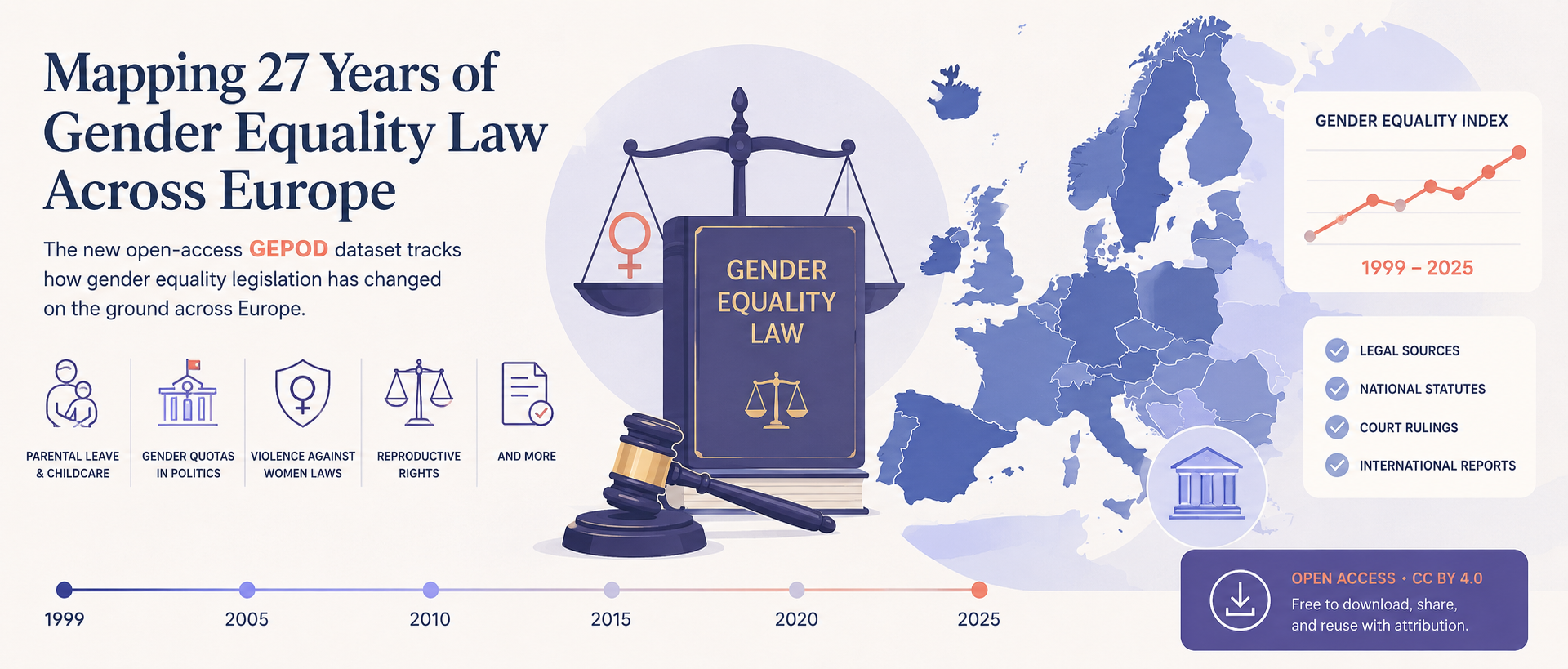
GEPOD covers 31 European countries (the EU-27 plus Iceland, Norway, Switzerland, and the UK) from 1999 to 2025, spanning 11 distinct policy dimensions, from parental leave and childcare funding to gender quotas in politics, violence against women legislation, and reproductive rights. That adds up to more than 9,000 country-year-dimension observations, each one anchored to real legal sources: national statutes, court rulings, and reports from bodies like the European Institute for Gender Equality and the Council of Europe's GREVIO monitoring mechanism.
Rather than relying on expert surveys or perception-based scores, GEPOD is built from primary legal texts. Every score change is tied to a specific legislative act, court ruling, or equivalent legal instrument, so users can trace exactly why a country's score moved in a given year.
The framework
The dataset organizes its 11 policy areas using the influential typology developed by political scientists Mala Htun and Laurel Weldon, which sorts gender policy along two axes: whether it targets women as a status group or involves class-based redistribution, and whether it challenges religious or traditional doctrine. That produces four categories, from parental leave and childcare (class-based, non-doctrinal) to abortion and family law (status- and class-based, doctrinal), letting researchers see not just how much gender equality legislation exists, but what kind.
From these categories, GEPOD builds a composite Gender Equality Index (GEI), giving each country a single comparable score per year, alongside four subindices for more granular analysis.
Why it matters
Data quality was clearly a priority here: independent coders cross-checked a sample of cases, and the team reports a Krippendorff's alpha of 0.87 overall, comfortably in "strong agreement" territory for this kind of legal coding work. That's the kind of detail that matters if you're planning to build a regression model on top of this, not just eyeball a map.
For anyone working on gender politics, comparative law, or policy diffusion in Europe, this fills a real gap: a legally grounded, longitudinal, cross-nationally comparable dataset that goes well beyond the usual handful of headline indicators.
Dataset: Lavrinenko, O., & Gryniuk, K. (2026). Gender Equality Policy Dataset (GEPOD), Version 1.0. Harvard Dataverse. https://doi.org/10.7910/DVN/MMEYQV — free to download, share, and reuse with attribution.